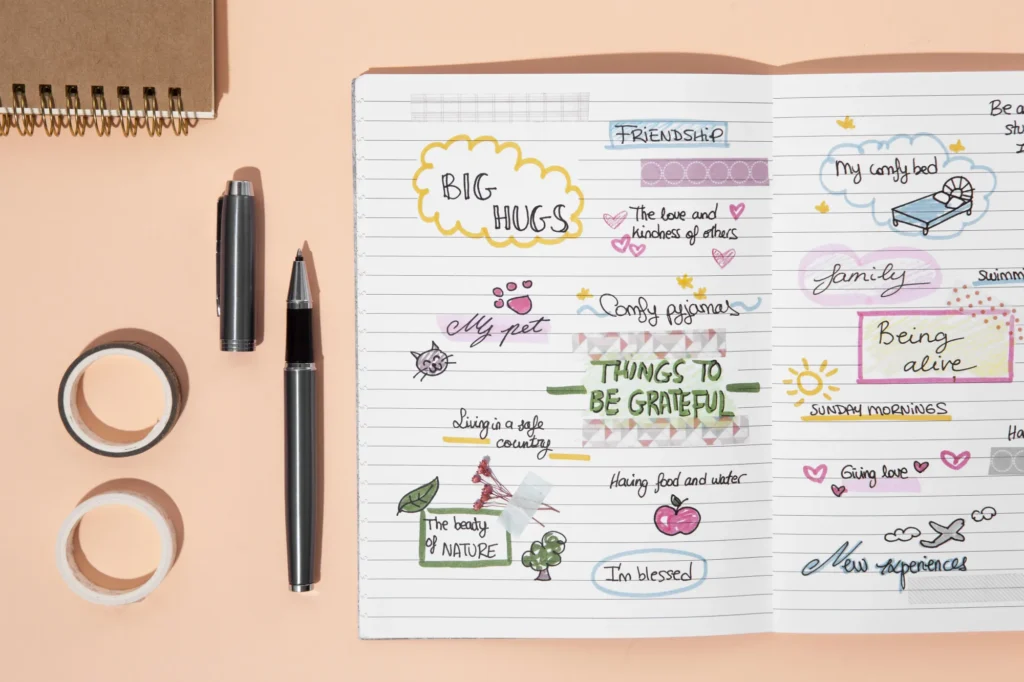
In Part 1, we saw how five minutes of expressive journaling can tame stress, lower cortisol, and even give your immune system a lift. Now, let’s go deeper – into your brain itself. What actually happens when you translate feelings into words? How does the simple act of writing help you manage tough emotions and build lasting resilience?
Self-Awareness & Emotional Processing: Neurological Insights
Putting Feelings Into Words – What’s Happening in Your Brain?
When you name your emotions – whether by journaling or just putting them into words in your mind – you are doing what researchers call “affect labeling.” This is more than just venting on paper. Neuroscience shows it creates measurable changes in how your brain processes emotions.
Calming the Emotional Alarm
Deep inside your brain sit a structure called the amygdala (pronounced as “uh-MIG-duh-luh”) – think of them as your emotional “smoke detectors”. When something stressful happens, they light up, signaling fear, worry, or upset. But something amazing happens when you label your feelings in writing. MRI (Magnetic Resonance Imaging) scans show that naming your emotions (“This is anxiety”; “I feel sad right now”) actually reduces activity in the amygdala. In plain words: writing about your feelings helps dial down your brain’s alarm system, making intense emotions feel more manageable.
Boosting Your Brain’s Self-Control Hub
At the same time, another region – the ventrolateral prefrontal cortex (vlPFC), just behind your forehead – becomes more active. This part acts like your brain’s steady hand, helping you understand, regulate, and work through emotions instead of being overwhelmed by them. The more you name and explore your feelings, the better this “regulation muscle” gets at guiding you through life’s ups and downs. 1 2 3
Why Does This Matter?
Research finds that people who regularly practice reflective journaling – especially the kind that involves naming and exploring emotions – build up these neurobiological “tools”. Over time, this practice leads to:
- Greater self-awareness: You spot and make sense of emotional patterns rather than being blindsided by them.
- Improved emotion regulation: You recover from setbacks faster and are less likely to be caught in spirals of anxiety, frustration, or rumination.
- Lasting resilience: These positive changes in brain activity are linked to improved mood, physical health, and overall life satisfaction months down the line.
“When you put your feelings into words, you’re literally shifting brain activity in ways that help you feel better and cope better.” (Putting feelings into words: affect labeling disrupts amygdala activity, PubMed)
What the Studies Show
One large MRI study found that people who practiced affect labeling while journaling saw reduced amygdala activation and greater vlPFC engagement, both while writing and in their daily lives afterward.
Astonishingly, these brain changes predicted improvements in depression, anxiety, physical health, and life satisfaction three months later.
In summary: The act of turning emotions into words is more than a feel-good practice. It’s a science backed way to build self-insight, calm your “worry circuits,” and strengthen your mind’s most resilient traits.
Final Thoughts: Start Changing Your Life – One Journal Entry at a Time
Science makes it clear: just a few minutes of reflective journaling each day can do wonders for your mind and body. By putting your feelings into words, you’re not only easing stress today – you are literally rewiring your brain for greater resilience and emotional strength tomorrow. Becoming more self-aware, learning to handle emotions, and even enjoying a stronger immune system – all of these benefits are within reach.
But as with any life-changing habit, the hardest step is often the first one – and sticking with it consistently. Here, I recommend MUJO, a daily journaling app.
Why Try MUJO, a daily journaling app?
MUJO is designed to be the simplest, friendliest way to make daily journaling a part of your life. You don’t need to worry about where to start or what to write – MUJO offers gentle prompts, easy reminders, and a clear, clutter-free space just for you.
- Looking to feel calmer and more in control?
MUJO helps you build a routine that lowers anxiety and clears away mental clutter. - Want to get to know yourself better, set meaningful goals, and track how you are changing day by day?
MUJO’s guided reflections and emotion tracking keep you focused on growth. - Concerned about privacy?
Every journal entry is encrypted and stays completely private, so you can freely capture your thoughts and emotions. - Need a little nudge?
Get daily reminders and streak tracking so you keep up the momentum
The act of journaling – even for five minutes – has been proven to support mental health, boost well-being, and sharpen focus.
Start your journey to a healthier, more mindful you – one journal entry at a time. Get MUJO, daily journaling app now
Ready to Start Your Daily Journaling Habit?
Try MUJO — Simple Journaling That Sticks
MUJO makes daily reflection effortless with a clean interface, bullet journal format, and timeline views that help you see patterns in your life. No clutter, no overwhelm—just you and your thoughts.
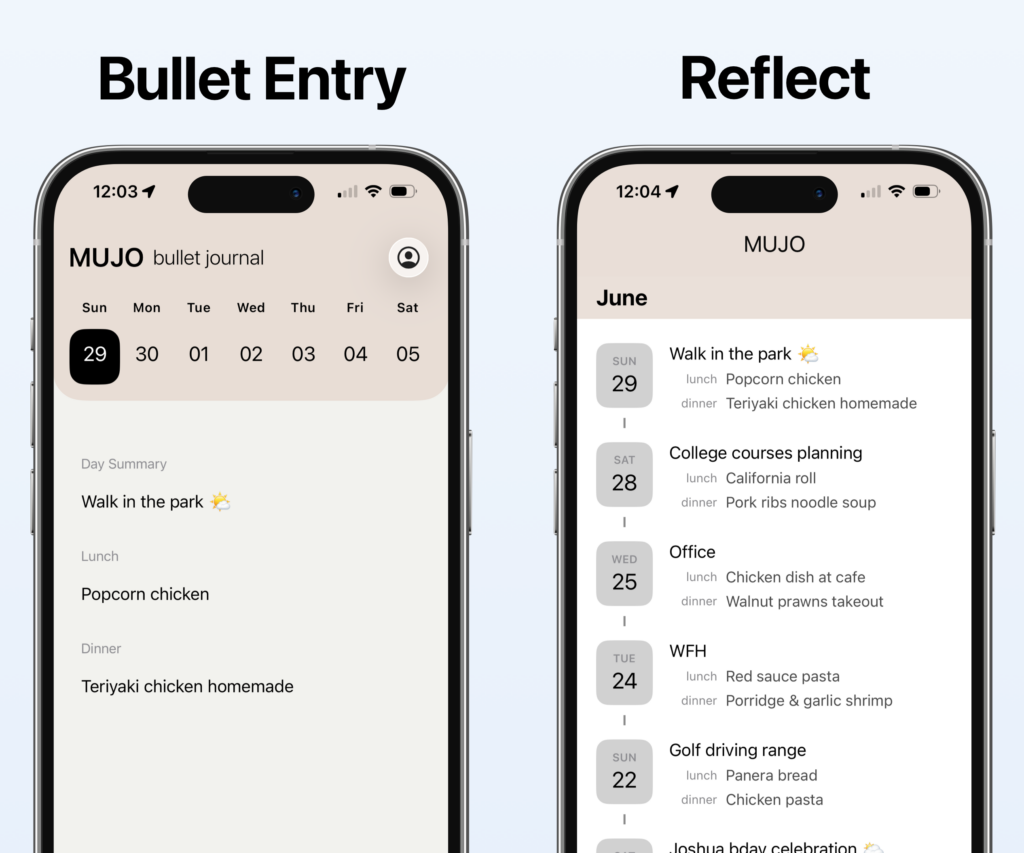
✓ Bullet journal and timeline views
✓ Track daily activities and meals
✓ Clean, distraction-free design
✓ Private and secure—your journal stays yours
Reference
- Putting Feelings Into Words – Affect Labeling Disrupts Amygdala Activity in Response to Affective Stimuli (Lieberman et al., UCLA) ↩︎
- The common and disctinct neural bases of affect labeling and reappraisal in healthy adults (Burklund et al., PMC) ↩︎
- Neural activity during affect labeling predicts expressive writing effects on well-being: GLM and SVM approaches (Memarian et al., PMC) ↩︎